
The fall of leaders and the lessons of shepherding

(Ezekiel 34:11-16, 20-24; Matthew 25:31-46) By Rev. Rick King—What a week! We’re witnessing members of Congress in both parties continue to wrestle with a tsunami of allegations of sexual harassment; the fall of Robert Mugabe, Zimbabwe’s only leader in its history; and the conviction of General Ratko Mladic for war crimes and genocide. And that was all before Thanksgiving; who knows what the next week will bring?

One of the things the Christian year and the readings associated with it can give us is a lens through which to see the world, that helps us connect the dots and make sense of events, understanding and even drawing lessons from history, so we can avoid repeating the worst, and at least make different mistakes. And as a result, you and I can come to know better how to live in the midst of it, as people of faith, and agents for change.

Today is the last day of the Christian year—you might call it New Year’s Eve in the church calendar. Because next Sunday, we begin the season of Advent, and with it, a new year in the liturgical cycle. Like any New Year’s Eve, it gives us the chance to look back and take stock of the good and the bad, the victories and defeats, and all that lies in between. This is Reign of Christ Sunday, also called Christ the King, and as you might expect, the question of “Who’s in charge?” in the world is central—and it feels even more urgent when something happens like the terrorist bombing of the Sufi mosque in Egypt—as in the sense of somebody walking into a room during a crisis and yelling, “Who’s in charge here?!”

The book of Ezekiel was trying to help Israel make sense of what had happened to them and why. They were exiled in Babylon, their leaders under house arrest in Jerusalem, which had been destroyed and occupied, their temple was in ruins; and the rest of the population had been scattered throughout the region, refugees invaded by a foreign aggressor and kicked out of what was supposedly their God-given Promised Land.

In the face of what had happened, how were they supposed to live now, as exiles in a foreign land and not knowing if or when they would ever return?
I might be stretching just a little bit, but many of you have intimated that you, too, feel a bit exiled right now in a nation you thought you knew, but which has come to seem like a foreign land.

The prophetic tradition, of which Ezekiel is a part, has a particular take on leadership: “Kings will let you down.” Israel wanted kings, eventually, as a sign to all the other nations that they had “arrived,” as a legitimate world power: Assyria, Babylon, Israel. “Get us a king,” they would say to God; and the prophets would say, “You don’t want a king.” And the history that runs through 1 and 2 Samuel and 1 and 2 Kings in the Old Testament is a compare-and-contrast piece proving, over and over, that it’s not having an earthly king alone that makes you a legitimate nation, but whether that king places God at the center, and love of God and neighbor are your goals.

The good news, says Ezekiel, is that God is through with irresponsible leaders, and is taking over. “I myself will be the shepherd of my sheep…I will seek the lost, and bring back the strayed, and will bind up the injured, and strengthen the weak—but the fat and the strong I will destroy. I will feed them with justice” (34:15-16).

Now, whether we can understand the recent fall of powerful leaders as God’s will or not, we can draw some lessons that help us live in the midst of it and not lose our perspective, and even be more effective agents for good in the lives of others, whether it’s our family members, or practicing just and kind covenant relations within our congregation, or advocating for systemic change in schools or the halls of government.

Ezekiel’s not the only place where God seems to take one look at what’s happening and says, “Okay, step aside; this is a mess; I’m taking over.” Jesus is doing it, too, in the vision of the Great Judgment, or what’s come to be called “the separation of the sheep and the goats.” And the message is simple, and one we often use as the measure of a faith, or a leader, or a government: “Whatever you did to the least of these my brothers and sisters, you did it to me.”

Right leadership leads as though it seeks God, seeks love in all things. M. Scott Peck tells a story called “The Rabbi’s Gift,” in his book, “The Different Drum,” that reminds us of the power of living this way:

The story concerns a monastery that had fallen upon hard times. It was once a great order, but because of persecution, all its branch houses were lost and there were only five monks left in the decaying house: the abbot and four others, all over seventy in age. Clearly it was a dying order.

In the deep woods surrounding the monastery there was a little hut that a rabbi occasionally used for a hermitage. The old monks had become a bit psychic, so they could always sense when the rabbi was in his hermitage. “The rabbi is in the woods, the rabbi is in the woods,” they would whisper. It occurred to the abbot that a visit to the rabbi might result in some advice to save his monastery.

The rabbi welcomed the abbot to his hut. But when the abbot explained his visit, the rabbi could only say, “I know how it is.”

“The spirit has gone out of the people. It is the same in my town. Almost no one comes to the synagogue anymore.” So, the old abbot and the old rabbi wept together. Then they read parts of the Torah and spoke of deep things. When the abbot had to leave, they embraced each other. “It has been wonderful that we should meet after all these years,” the abbot said, “but I have failed in my purpose for coming here. Is there nothing you can tell me that would help me save my dying order?”

“No, I am sorry,” the rabbi responded. “I have no advice to give. But, I can tell you that the Messiah is one of you.”

When the abbot returned to the monastery his fellow monks gathered around him to ask, “Well what did the rabbi say?”

“The rabbi said something very mysterious, something cryptic. He said that the Messiah is one of us. I don’t know what he meant.”

In the time that followed, the old monks pondered the rabbi’s words. The Messiah is one of us? Could he possibly have meant one of us monks? If so, which one? Do you suppose he meant the abbot? Yes, if he meant anyone, he probably meant Father Abbot. He has been our leader for more than a generation. On the other hand, he might have meant Brother Thomas. Certainly, Brother Thomas is a holy man. Everyone knows that Thomas is a man of light. Certainly, he could not have meant Brother Elred! Elred gets crotchety at times. But come to think of it, even though he is a thorn in people’s sides, when you look back on it, Elred is virtually always right. Often very right. Maybe the rabbi did mean Brother Elred. But surely not Brother Phillip. Phillip is so passive, a real nobody. But then, almost mysteriously, he has a gift for always being there when you need him. He just magically appears. Maybe Phillip is the Messiah.

Of course, the rabbi didn’t mean me. He couldn’t possibly have meant me. I’m just an ordinary person. Yet supposing he did? Suppose I am the Messiah? O God, not me. I couldn’t be that much for You, could I?

As they contemplated, the old monks began to treat each other with extraordinary respect on the chance that one among them might be the Messiah. And they began to treat themselves with extraordinary respect.

People still occasionally came to visit the monastery in its beautiful forest to picnic on its tiny lawn, to wander along some of its paths, even to meditate in the dilapidated chapel. As they did so, they sensed the aura of extraordinary respect that began to surround the five old monks and seemed to radiate out from them and permeate the atmosphere of the place. There was something strangely compelling about it. Hardly knowing why, they began to come back to the monastery to picnic, to play, to pray. They brought their friends to this special place. And their friends brought their friends.

Then some of the younger men who came to visit the monastery started to talk more and more with the old monks. After a while one asked if he could join them. Then another, and another. So, within a few years the monastery had once again become a thriving order and, thanks to the rabbi’s gift, a vibrant center of light and spirituality in the realm.

The Messiah is one of you.

Amen.
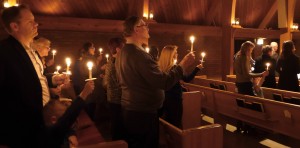
Worship with us Christmas Eve

On Christmas Eve, Sunday, Dec. 24, come and experience the joy of this holy season. Join us for one (or more) of three worship services celebrating the coming of the Christ child:

  • Morning worship at 10:30 a.m., with special music and a Christmas message.
  • Our family-friendly 4:30 p.m. service, with stories and songs suitable for all ages.
  • A candlelight service at 10 p.m., with our Chancel Choir and “Silent Night” sung in the darkened sanctuary.


Ring in the new year with our bell choir

If you’ve always wanted to try playing in the bell choir but were afraid to try, now’s your chance!

We need quite a few ringers to fill out a choir again. So when you join, you’ll be in good company with other newbies.

Contact Carol Meeter if you’d like to learn more (651-647-4430, [email protected]). You can also leave a message in the box in the church office.

Buy a blossom to help the food shelves

Help our neighbors in need by buying a white silk poinsettia for our Gathering Room Christmas tree! All proceeds from these sales will go to restock local food shelves.

Rather than offering live poinsettias for sale this year, we recognize that many people in our communities are struggling to make ends meet. So we’ve decided to redirect the money that would have been spent adorning the sanctuary to helping those who are food-insecure.

The silk blossoms are $15. Tell us who you’re honoring or remembering with your blossom by filling out the attached order form. Pay at the Scrip table during coffee hour through Sunday, Dec. 17, and hang your flower on the tree. Or you can send the form to the church office by Monday, Dec. 18, and we’ll hang a blossom for you.

Make checks out to Falcon Heights Church UCC and include the notation “Ornament.”

Along the Borderlands

Read Rev. Rick King’s blog about racial divides and reconciliation in our community.

December donations for Dept. of Indian Work

During December, we will collect cleaning products for the Department of Indian Work. Clients of the agency need kitchen, clothing, dishwashing and general use cleaning products. Government assistance does not cover these items.

We also continue to collect low-sugar cereal, instant oatmeal packets and granola bars for children at Falcon Heights Elementary School. These breakfast items go home with students on the weekend.

Please bring donations to the church lobby.

Christmas giving opportunities

This Christmas season, share the gifts of remembrance and warm clothing for those in need. Here are two opportunities:

Christmas gifts for seniors

We are collecting money donations and gift cards to purchase gifts for seniors at Lyngblomsten Care Center who do not have families or visitors to remember them at Christmas. The Lyngblomsten staff will use your donations to buy gift items for the residents.

Suggested cards include Target, JCPenney, Walmart, Kohls and Macy’s. You can buy these at the Scrip table during coffee hour. Please make checks payable to Lyngblomsten Foundation. Look for a designated donation box in the church lobby. We’ll take the donations and cards to Lyngblomsten Friday, Dec. 8.

Christmas hats and mittens for kids

Look for the tree in the lobby, where we’ll collect hats and mittens for children and youth. The Department of Indian Work at Interfaith Action in St. Paul will distribute your gifts to its clients. Bring donations by Sunday, Dec. 17.

Allies don’t rest

(Zephaniah 1:7, 12-18; 1 Thessalonians 5:1-11) By Rev. Rick King—When we discussed these two texts on Tuesday morning in Bible study this week, we all pretty much agreed that we liked Paul’s words in the second one a LOT better than Zephaniah’s in the first. Zephaniah is harsh, his God is angry at something the people have done, and seems to have it in for them. It fits all the negative stereotypes of a vengeful God that turn people off on Christianity.

More than that, it overturns our expectations for the Sunday before Thanksgiving: In normal years, we expect—indeed, we may feel entitled to—an early celebration of Thanksgiving, where we can look back and count our blessings. And this year would seem to be a season in our church’s life that brings forth more praise and thanks than usual for all that God is doing. And in Zephaniah, it seems from the context that the people he’s speaking to were expecting something different from him, as well—a message congratulating them on how well they were doing as God’s people.

I think this is important, because today is not only the Sunday before Thanksgiving, but also our observance of Transgender Day of Remembrance, which was started in 1999 to remember and mourn the lives taken by transphobia-motivated violence. At this time of year, as the temperatures drop and the nights become long in the Northern Hemisphere, the seasons in the Christian Year invite us to turn inward and get more reflective. Two weeks ago, All Saints’ Day reminded us of the shortness of life and the faith legacy of people close to us who have died. In two more weeks, we will begin the season of Advent, when we are invited to prepare for the coming of Jesus by doing a spiritual housecleaning of sorts.

Don’t worry, it won’t all be introspective: We have Schubert’s Mass in C and “Just a Lowly Camel,” this year’s Christmas pageant, coming in the two Sundays after that! But as a church, we need to be able to look at hard things, and take a hard look at ourselves and the human condition, without shrinking. Beware of a church that can’t do this, in which everything needs to be sweetness and light all the time; beware a church that can’t do dark. Not everything is gloomy all the time, but not everything is all good.

So, to set the context a little bit more: Both of our readings deal with something called “the Day of the Lord,” a time of reckoning and taking stock, and if you and I were doing such an inventory of our lives, both Zephaniah and Paul would prompt us to ask how we’re doing as people of faith—both in the gratitude department, AND the “Allies” department. After all, things are different in the world than we would like them to be, and part of a prophet’s role is to name things for what they are, and that’s what Zephaniah is doing. He might be saying to us that today is a day of deep anguish at the culture of death that’s reemerging around the rights of transgender and gender non-conforming people.

In the gratitude department, you and I would be remiss if we didn’t recognize and give thanks for the progress that’s been made in LGBTQ rights in the last decade; yet we can’t rest on our laurels, or what Zephaniah calls “our dregs”—the long-ago-won victories of the past. In the “ally” column of our inventory, we need to address our vigilance, or we will witness the undoing of all those victories won since Stonewall. And as a cisgender, straight white male, I know I really have a lot of catching up to do on trans rights and what life is like for members of the trans community. And what I can do as an ally.

In our inventory, the gratitude and the vigilant ally columns are related: true gratitude and a focus on the progress we’ve made encourages us and spurs us to further action, because we know we can make a real difference. At the same time, if we ask regularly how we’re doing as vigilant allies, we can keep from putting on rose-colored glasses and have a more accurate grasp on reality, which provides its own kind of motivation to be agents of change in the lives of those who are in peril.

If we were to imagine what Zephaniah and Paul might be saying to us on this Trans Day of Remembrance, it might go something like, “Beware of treating ONA as though it’s a finish-line, because that’s an illusion: it’s really only a starting line, and you shouldn’t think, ‘Whew! Thank God we’re ONA!’ and slack off; that’s living in the dregs; and allies don’t rest when there’s justice to be done. Being ONA is a trust, and if we’re not moving forward, we’re moving backward.”

And yet, I get the feeling I’m reminding you of things you already know, and this is where Paul’s approach is helpful. He says in the opening words of our chapter, “You don’t need to have anyone write to you about times and seasons. For you are children of the day, and you already know what time it is.”

But we take time out on this day to focus on the fact that trans lives are still being lost—indeed, the rate of hate crimes and suicides based on gender identity and gender expression are on the rise again. Rights of trans members of our military are being rolled back, as are employment protections for LGBTQ folks in the workplace. Not to mention the continuing health care challenges trans folks face from a lack of understanding and acceptance of their distinctive set of medical needs.

So there’s a great deal yet to be done. Part of a prophet’s role is to interpret the signs of the times through the lens of God’s will, and if we take that look through clear eyes, Zephaniah’s view looks right on—pretty bleak, I admit, but right on. Zephaniah’s warning is also there in Paul’s words to the church at Thessalonica: Remember who you are, and how important this is. Don’t let the Day of the Lord come upon you like a thief in the night: Don’t underestimate how bad things are, and how much worse they can get if good people rest on their laurels of what they’ve done in the past, but do nothing in the present.

So on this day of mourning, let us remember the lives lost because of transphobia and neglect of the rights of these precious children of God. And the Day of the Lord is never a day of doom in the Bible; it’s always a day of turning and transformation, of our lives, and the lives of all. Amen.

Donations for Department of Indian Work

Our donations to the Department of Indian Work food shelf in November will emphasize hygiene items, including toothbrushes, toothpaste, assorted forms of soap, shampoo and women’s sanitary supplies. No government assistance covers these items, so recipients have to buy them with their limited incomes.

In addition, we are still collecting coats and outerwear in good condition.

We also continue to collect low-sugar cereal, instant oatmeal packets and granola bars for Falcon Heights Elementary School. These breakfast items go home with students on the weekends.

Please bring donations to the church lobby.

Gifts for Lyngblomsten residents

We are collecting money and gift cards to purchase gifts for seniors at Lyngblomsten Care Center who do not have families or visitors to remember them at Christmas. In turn, the Lyngblomsten staff will use your donations to buy gift items for the residents.

Suggested cards include Target, JCPenney, Walmart, Kohls and Macy’s. You can purchase them at the Scrip table during coffee hour. Please make checks payable to Lyngblomsten Foundation.

There will be a designated donation box in the church lobby. We will take the donations and cards to Lyngblomsten Friday, Dec. 8.